
On the eve of America’s birthday, let’s talk about America’s carpet history which is complex and interesting. You may be surprised to learn that an important part of it began right here in Philadelphia.
The plush, wall-to-wall, easy-care carpeting that most of us take for granted is actually a recent phenomenon in history. Worldwide, few people today have this type of carpet in their homes. They are much more likely to have hard floors of some type – either wood, stone, tile, or cement – with area rugs scattered about for warmth, comfort, and aesthetic value. This type of rug has always been relatively easy to clean without a power vacuum by taking it out and beating regularly to remove dirt and dust.
The Early Threads: 18th and 19th Centuries
America’s love of the more luxurious type of carpet dates back to 1791 when William Sprague opened his woven carpet mill in Philadelphia. This marked the inception of domestic carpet manufacturing, which expanded throughout New England in the early 1800s. By 1834, there were 20 carpet mills producing approximately 1 million square yards annually. This number grew to 116 mills by 1850, reflecting the industry’s rapid growth.
A significant milestone occurred in 1839 when Erastus Bigelow invented the power loom for weaving carpets. This innovation doubled carpet production within a year and tripled it by 1850, revolutionizing the industry and making carpets more accessible to the American public.
Industrial Expansion and Innovation
The late 19th and early 20th centuries saw further advancements in America’s carpet history. In 1878 the Shuttleworth brothers started the Mohawk carpet company in Amsterdam, New York with 14 looms imported from England. In 1905 Mohawk introduced a new carpet, the Karnak Wilton, which achieved popularity almost overnight. The company had to expand into new quarters just to meet demand.
Another notable figure was Catherine Evans Whitener, who, in the late 19th century, revived the craft of tufting in Dalton, Georgia. Her handmade bedspreads led to a cottage industry that evolved into mechanized carpet production, positioning Dalton as the “Carpet Capital of the World.”
The Rise of Tufted Carpets and Synthetic Fibers
In the 1920s Oriental rugs began to be manufactured by machine. This was the brainchild of Marshall Field. At this time in American history, the most popular rug material still, by far, was wool.
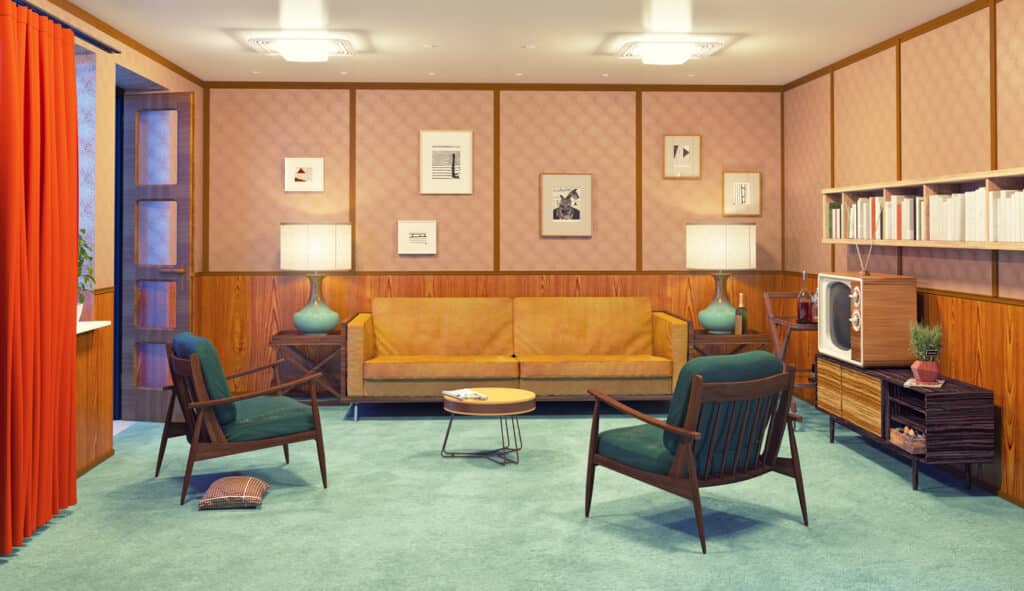
However, after World War II, new fiber technologies changed everything in carpet production. There were new man-made fibers, spinning techniques, dye equipment, tufting equipment, and printing processes. Not only that, suddenly there was demand. This was the era of tract housing, and all of the ranch houses being built for the Baby Boomers and their parents needed flooring. Wall-to-wall carpeting eventually became the solution of choice.
This was the 1950s and everything “scientific” was the rage. The last thing any modern housewife wanted on her floor was Grandma’s rag rug or even a loom-made Oriental. Nylon had been created in a lab. It was scarce during the war years, but technology and Southern manufacturing (with its lower union-free labor costs) made it affordable to even young, working class families. So they had it installed.
In the mid-1950s, Dupont developed bulk continuous filament (BCF) nylon and this facilitated the introduction of the more inexpensive low pile looped carpet suitable for the working class family’s budget and lifestyle. Nylon also lent itself to a variety of styles and constructions that allowed for more options in interior design. With the explosion of consumer goods, personal style was now an achievable goal.
These developments made carpets more affordable and durable, catering to the needs of the growing middle class. By the 1960s, carpet sales had reached $1 billion annually. Dalton, Georgia, became the epicenter of this growth, with over 150 carpet plants operating in the area. Today, more than 90% of functional carpet produced in the world is made within a 65-mile radius of Dalton.
Bond Products experienced this carpet transformation firsthand. Our products have made it possible for both new and old types of carpet to be installed or adapted elegantly and easily, and we’ve always been excited to see how flooring changes and is modified to suit more modern lifestyles.
America’s Carpet Industry Today
In the 21st century, America’s carpet industry continues to thrive, adapting to changing consumer preferences and environmental considerations. The industry also focuses on sustainability, with efforts to recycle carpet materials and reduce environmental impact.
America’s carpet history reflects a journey of innovation, resilience, and adaptability. From the first woven carpets in Philadelphia to the global dominance of Dalton’s tufted carpets, the industry has continually evolved to meet the needs of consumers. As it moves forward, the American carpet industry remains a testament to the nation’s entrepreneurial spirit and commitment to quality craftsmanship.
